The Natural Playgrounds Company, LLC® is the leading US experts in the design and construction of innovative, environmentally sensitive, equipment-free natural playgrounds, natural playground elements, and outdoor classrooms, for K-12 schools, Montessori schools, Head Start programs, childcare centers, communities and mud competitions.
Tuesday, September 15, 2015
Off to the Races! Mud Run, Fitness Challenge Races, that is.
We got started by designing and building #mudruncourses for two event companies, several fitness courses for a New England city, and then mini challenge courses for child care centers, and then realized we should offer these elements to everyone, because obesity is the number one issue is this country due to lack of exercise!
When you click over to our website, you'll can see from the pictures featuring both young children and adults, the elements can be scaled to fit any age group, because no matter what their size, they offer the challenges that increase physical fitness, balance, agility, and awareness of self.
The prices shown listed under the photos on the website are for adult-sized elements, so if you want elements for children, please ask!
Family fitness runs (many of which involve mud :) are great fun and great fund raisers, but lots of times, even though you may want to put one together, buying or setting up the fitness elements are a little beyond your reach, so we have both a rental and an installation program that might help you get over these impasses.
You are interested in a temporary challenge? We can help with that as well. Here’s what we worked out for rentals anywhere in the contiguous US!
For each element, rental is $684.95 per day of use (we don’t charge for the time elements are in transit), with a 2 day rental minimum. This rental fee includes shipping!
If you want help setting up and breaking down the elements:
For between 1 and 4 elements, we charge a total of $1173.95 per element per day (again with a 2 day minimum). This includes the rental, shipping both ways, installation, and dismantling.
For between 5 and 8 elements, we charge a total of $1078.95 per element per day (again with a 2 day minimum). This includes the rental, shipping both ways, installation, and dismantling.
Call or email us, and let us help you put together a fun and exciting fitness run!
Tuesday, September 1, 2015
No One Should Want a Risk-Free Playground!
Happy September!
For many of you reading this post, you've already prepared your children for another school year. Another year of new experiences, new best friends and new lesson plans.
Playground safety is everyone's concern, but protecting children from all harm is simply impossible, and research is also supporting the assumption that protecting children from all possible danger is unhealthy.
Children of all ages need to learn how to manage risk so as adults they're able to handle the risk in everyday living and decision-making.
It's up to you to provide safe or acceptable risk situations on your playground, whether that means your backyard play area or the play yard at your child's school. The more natural you can make your play environment, the more children will be able to experience safe risk encounters that force them to make play decisions teaching lifetime lessons.
Life lessons are not always learned in a classroom. Life lessons very often happen on the playground.
Encourage your children, your students to be careful, but not stop them from experiencing life to its fullest!
We want to wish you a most successful and enjoyable school year!
Wednesday, June 3, 2015
How Protecting Our Children Can Hurt Them.
We recently discovered this article online by Angela Hansom who is a pediatric occupational therapist and the founder of TimberNook. We wanted to share her Three Examples of How Play Outdoors can be Therapeutic because we so appreciate the critical importance of her science and the discoveries that she, and so many others in her field, have made regarding children and their need for physical exploration.
As you read Hansom's examples, we'd like for you to remember your own youth and what playing outside meant to you. What lessons you learned. What bonds were forged. What scraps and bruises healed and were replaced by childhood memories that will never be forgotten.
Three Examples of How Play Outdoors Can Be Therapeutic:
- Sledding: If you are lucky enough to have snow, sledding is a great sensory activity, especially if you frequently change positions on the sled. For example, if children go down the hill on their bellies, keeping their head and legs up in a superman position, this activates the vestibular (balance) system and improves body awareness over time. Flying saucers send children around and around, helping to establish a good sense of space.
- Walking barefoot in the woods: Walking barefoot on uneven terrain helps to challenge and strengthen the muscles in the ankles and develop the arches of the feet. It also helps to develop a reflex in the foot that helps prevent toe-walking. The sensations of dirt, sticks, and leaves on the bottom of the feet develop healthy touch senses and furthermore, assist with preventing sensory defensiveness on this part of the body. Running through the woods teaches children to effectively and efficiently navigate their environment, while challenging their balance at the same time.
- Rolling down a grassy hill: Rolling down the hill helps to provide necessary deep pressure to the muscles and ligaments – improving the proprioceptive sense. This sense is fundamental in helping children accurately regulate how much force to use when playing games like tag, coloring with crayons without breaking them, and holding a baby chick without squeezing too hard. Also, as the child rolls, they are spinning, which helps to develop a strong vestibular (balance) system.
If you'd like to read Hansom's complete article, please visit childrenandnature.org
For more information about Natural Playgrounds, visit our website at www.naturalplaygrounds.com
If you'd like to share a few of your childhood memories with us, please leave a comment below.
Thursday, April 9, 2015
What Happens When Kids Get Bored?
We speak with many administrators who are leery about safety and standards compliance with nature play. We understand their concerns. One child hurt is too many.
Our embankment slides are very popular. We have been asked to create playscapes using these slides because of the fun they provide, but we do get asked occasionally if they are safe. We wanted to share several thoughts from the founder of Natural Playgrounds Company regarding hillside slides and nature-based play that may help you determine if this is the right playground for your child and your community.
"...accident rates on traditional, equipment-based playgrounds continue to climb. According to the National Orthopedics Association, accidents on equipment-based playgrounds cost the US almost $14 billion a year, and some of those accidents result in deaths.What this is saying it that in spite of passing all the stringent safety tests, and meeting all of the safety requirements and guidelines, equipment-based playgrounds are so unsafe that the accidents on them cost the US almost $14 billion a year!.... yet equipment manufacturers have no problem guaranteeing parents that children will be safe playing on their equipment because it has all been tested by ASTM/CPSC/IPEMA to be safe.How can this possibly be? How is it that accidents on traditional, equipment-based playgrounds continue happening at this alarming rate? $14 billion!We couldn't figure it out, and none of the safety experts could provide us answers, either, so we decided we needed to ask children what's going on.We interviewed 6000 of them, and they all gave us a very simple answer.Manufactured playgrounds are boring.The first day of school, it's all very exciting. The second day of school, it's the same thing as it was yesterday. The second month of school, it's the same thing it was the first day. The second year of school, it's the same as it was the first day.Couple that with the sea of wood chips or rubberized surfacing, and you have a play environment that is absolutely lifeless, unchallenging, and leading to no discovery-oriented play, which is where the fun really is.
When children get bored, they do things on the equipment for which it was not designed: running up slides, and falling off the sides. Pushing each other out of boredom, sometimes over the sides of equipment. Climbing up on the tops of railings to jump off doing helicopters. Shinnying up swing supports so they can hang from the crossbar. Anything that makes play more exciting, but in being rambunctious on equipment elevated above the ground, they get in accidents, one after the other, to the tune of $14 billion a year here in the US.In stark contrast to this, accident rates on natural playgrounds are almost nonexistent. The whole concept is to provide so much ground-based, discovery-oriented play based on natural landscapes, that children (and adults) constantly find new things, changes that take place overnight, insects and wildlife that inhabit the natural environment, giant, deep, freeform sand play areas with old-fashioned pitcher pumps so they can make big sand sculptures and dig to China, big logs lying on the ground so they can sit on them or straddle them, big hills they can run up and roll down......and built into those hills at ground level, they find exciting things to do:• amphitheaters with stone or log seats for sitting on the hill that faces a stage for dramatic play• a slide built into the hill, so there is no place to fall off the sides, with a typical fall zone at its base• a climbing wall built into the hill, with a typical fall zone at its base• shallow caves• rock scrambles• forts built into the tops of hills• and many other features that make the three-dimensional hill an exciting place to be.Then there are gardens that are part of the play area so children can play play in them, dig in them, weed them, harvest them; and there are groves of trees, and shallow streams, and rain gardens, and sound gardens, and huge loose parts play areas.There are literally no heights from which children fall, which makes natural playgrounds inherently and significantly safer than the traditional equipment-based playgrounds to which you refer.
Every one of our playgrounds is designed to meet all ASTM and CPSC standards, and CPSI's who come to inspect them have fewer issues with them than with traditional, equipment-based playgrounds. ADA is pleased with them, as well, because play elements on natural playgrounds are all ground-based and very easily accessible..... we are trying to expose them to much more calm, discovery-oriented, nature-based play experiences that teach them about their bodies, nature, social interaction, and collaboration.When I was a child, I would make forts out of branches, or I'd climb a tree and hug the trunk, or I'd lie on my back and look up at the leaves and pine needles against the sky, or I'd look down and find a dog toothed violet poking its spring head up through the leaves, or I'd sit and push the leaves around me into a circle that became my room, or I'd pick the wild strawberry in the field, and watch a grasshopper perched on a strand of grass moving in the gentle breeze.These are the kinds of experiences we are trying to bring to play environments".
Ron King is president of the Natural Playgrounds company headquartered in Concord New Hampshire. The company designs and constructs Natural Playgrounds all over the US and can be reached through the web at www.NaturalPlaygrounds.com, by e-mail at info@NaturalPlaygrounds.com, or by toll-free phone 888-290-8405. Their website is full of research, pictures, fundraising sources, and information about Natural Playgrounds. Their store carries many of the items mentioned in the article.
Tuesday, December 2, 2014
The Innocence of Natural Play: Creating Unstructured Play Environments
Iʼve seen movies of bears wrestling with each other, monkeys playing and laughing together, squirrels chasing each other in trees, and cats batting dangling string, rolling and chasing balls, and pouncing on wind-up mice.
And us? Donʼt we do the same kinds of things, and sometimes go to great lengths to take a break from routines and have fun?
All of us are busy, but we do look for moments here and there to grab a coffee, see a movie, go out for dinner, take a drive, chat with a friend, or watch TV.
And boy, does it feel luxurious when we actually have time to unwind and hike, or fish, or garden, or swim, or paint, or read, or pursue our hobby....or just take a long, wonderful, quiet nap in the middle of the day. Anything that doesnʼt involve a schedule or an obligation or meeting a deadline is just plain precious to us.
Unstructured, unscheduled, free time. There is absolutely nothing like it.
But our lives are so full of family and work obligations, that finding that kind of time for ourselves is really difficult and, for me (and you, too, perhaps), it almost becomes an obsession.
What happened to the days of our youths when all we ever thought about was play? Maybe itʼs too long in the past to be certain, but when I was eight, I remember endless days. Hours and hours playing trucks and cars in my friendʼs dirt driveway, playing in the hilly field by my house, playing with wooden bricks my dad made from a 2x4, climbing trees, and making forts and tree houses in the woods.
Hours! And you probably did similar things, too!
Some time ago, we developed an interactive presentation about Natural Playgrounds, and one of our exercises asks people to tell us about the favorite things they did outside when they were 8 or 10 years old.
The answers are fun: climbing trees, making forts, making mud pies, climbing rocks, digging in the sand, running through tall grass, looking for bugs, playing in the water, walking in the woods, jumping in leaves, making sand castles, making snow angels.... [now would be the perfect time to get outside and make snow angels, right?]
![]() |
| [photo credit: the curious me.com] |
So hereʼs the importance of these memories: all of the play activities, every single one of them, was unstructured. As kids, these adults made up their own rules, their own actions, made discoveries, learned how to do things on their own, took risks, solved problems, got satisfaction, laughed, had fun, felt successful -- all because they were left on their own to play in an environment that encouraged imagination and exploration.
Unstructured, free play. Thatʼs what made the memories indelible.
Contrast that with play experienced by most children today. Inside a fenced playground usually filled with woodchips and nothing different or exciting day after day, they find themselves bored. Thereʼs no place to explore, no discoveries to make, no imagination required, no risks to take, no nature to watch...everythingʼs the same, same, same every time they come on the playground.
But thatʼs not all. Over the past 40 years, thereʼs been a 50% drop in unstructured outdoor activities, structured sports have doubled, homework has more than tripled, kids spend more than 30 hours a week with electronic entertainment, recess has been reduced or eliminated in 40% of US elementary schools (some schools are even being built without playgrounds), and parents continue to fully book their childrenʼs free time with organized activities like sports, swimming, archery, computer camps, choir practice, and dance lessons.
We're are quickly approaching the end to this year, whirling fiercely toward 2015. Make it your mission to get you, your family, your children, your neighbor's children - outside. On a whim, collect your family and go for a hike or take a walk around the block and see all the holiday decorations. Do something spontaneous. Get outside. Make a few memories.
Citations
Pyle, R (2002) Eden in a vacant lot: special places, species, and kids in the neighborhood of life.
Kellert, S (2002). Experiencing nature: affective, cognitive, and evaluative development in children
Healy, J (1990) "Endangered Minds: Why Our Children Don't Think and What We Can Do About It."
Ron King is president of the Natural Playgrounds company headquartered in Concord New Hampshire. The company designs and constructs Natural Playgrounds all over the US and can be reached through the web at www.NaturalPlaygrounds.com, by e-mail at info@NaturalPlaygrounds.com, or by toll-free phone 888-290-8405. Their website is full of research, pictures, fundraising sources, and information about Natural Playgrounds. Their store carries many of the items mentioned in the article.
Monday, September 15, 2014
Playing in the Sand - Naturally; Part 2
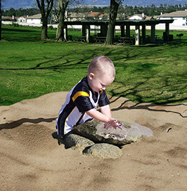
School may be back in session, but there's still plenty of time to get outside or get to the beach and PLAY in the Sand. A few short months ago, we wanted to share our thoughts about the importance of sand play. We believe that sand represents an empty canvas to children. Sand is something that children can explore, manipulate and learn from.
But many playgrounds are designed to use sand in restrictive ways. Used within typical playgrounds, sand is usually found in a small "sand table" or in buckets. But how can children explore their vivid imaginations if they can't experience SAND as nature intended? That blank canvas quickly becomes a scrap piece of paper with pre-determined lines drawn on it.
Children find sand boxes limiting. Whenever we've seen a sandbox adjacent to a sand pile, children are never in the confined box. They're always in the free-form area, playing with abandonment.
When sand is where it’s supposed to be, children love playing in it. They can dig to China, find “fossils,” hunt for gems, make roadways, build mountains, create waterways, build sand castles, dig tunnels, and discover hidden treasures. If they mix sand with water, they can make shapes of almost any kind.
And while children are in the sand playing, they are still learning. What are they learning?
* When sand is wet, it changes color. And when wet sand gets very cold, it freezes solid.
* When sand is wet, it can be shaped, and the finer the sand, the more intricate the shapes can be.
* Sand is comprised of many tiny particles of various sizes and colors which children can sort and collect.
* Sand, like other fine materials, slips through the small cracks in their hands, so children learn to clasp them together more tightly when trying to contain fine materials.
* If children try building a bridge using sand, they learn that it won’t support itself and that they need something with more “structural integrity” like a stick or a piece of wood.
* Sand can be portioned and divided, and added and subtracted. More is heavier, less is lighter, and to get more, you take more, and keep adding until you have just the right amount, a decision in itself.
* Sand can bury or “hide” things, like treasures, which can be found later.
* Sand particles get into everything: pockets, fingernails, sneakers, hair, lunchboxes, and classrooms. Sand makes a floor very slippery.
* When it rains, rivulets can move sand, and make beautiful, smooth patterns.
* But if children try making a sand dam, they soon realize it won’t hold water.
If our firm were designing a Natural Playground for a childcare center, school, or community, this list would comprise the “design parameters” for a free-form, sand play area. Similar parameters would be developed for every other aspect of a Natural Playground, because they’re the ultimate outdoor classrooms that should challenge and inspire children while teaching them lessons about themselves and about nature.
For more information about Natural Playgrounds, visit our website at www.naturalplaygrounds.com
By Ron King, M.Arch, CPSI
President, The Natural Playgrounds Company
Monday, May 19, 2014
Playing in the Sand – Naturally
Sand. It’s one of the few manipulatives that truly allows
children to explore their imaginations.
Unfortunately, in most play settings,
sand is treated as just one more controlled play item: it’s kept in containers
until it’s used in a plastic “sand table.”
The beauty of sand, is that it’s a material found almost
everywhere on earth. It’s unsettling that children see it stored in a table or
in a bucket on a shelf along with crayons and toys, totally disconnected from
its natural setting.
Not much of it fits in a sand table, and there’s no room to
build anything complex, such as road systems or mountains. Children stand at
the table, rather than play on their hands and knees, and many are required to
wear aprons so they don’t get dirty.
We’re pretty certain that these are not good lessons for
children.
Children also find sand boxes limiting. Whenever we’ve seen
a sandbox adjacent to a sand pile, children are never in the confined box.
They’re always in the free-form area, playing with abandonment.
And while children are in the sand playing, they are still learning. What are they learning?
- That sand has what is called a “slump” characteristic, so when poured, sand will form a mound, the slopes of which vary in angle depending on the size of its granules and the dampness of the sand.
- That on a sunny day, the surface of the sand will be hot, but when children dig down, they find coolness.
- That when water evaporates from a structure made with sand, it collapses.
- That when too much water is added, structures don’t hold their shape.
- That sand is portable, so children find many ways to move it by pushing it, pulling it, putting it in and pouring it out of containers, carrying it by hand, shoveling it, moving it by dump truck, and pouring it out of funnels.
- That if they dig deep enough on a beach, and children find water; deeper still, they’ll discover that their holes collapse.
- That when children are barefoot, their feet and bodies have to adjust in surprising ways to accommodate the ever-changing surface of sand.
To children, sand is an empty canvas.
By Ron King, M.Arch, CPSI
President, The Natural
Playgrounds Company
For more information about Natural Playgrounds, visit our
website at www.naturalplaygrounds.com
Subscribe to:
Posts (Atom)